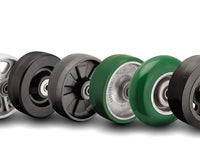

Quick Facts
|
Materials |
Glass filled Polypropylene and Glass Filled Nylon |
|
Profile |
Hard, moderately crowned tread |
|
Bearing |
Plain, Delrin, or Precision Ball (model-dependent) |
|
Durometer |
65–80 Shore D |
|
Temperature |
Varies by version; ranging from 250°F to 480°F continuous |
|
Typical Capacities |
800 to 1,400 lbs per caster (based on size & selected rig) |
What Makes Glass-Reinforced Wheels Different?
An economical hard wheel for tough applications.
Available in various versions, from economical polypropylene materials to heavy-duty nylon and high-heat versions – these wheels provide trusted mobility in an array of tougher environments. From applications involving water, chemicals, steam or high-temp processing, there’s a version built for the job.
Molded strength, not bonded.
Each wheel is molded from a single, glass-filled nylon or polypropylene compound –meaning no risk of tread separation like other polyurethane or rubber wheels. Use nylon for greater durability and life in heavier-duty applications—they include impact modifiers and temperature stabilization formulants to better handle shock and impact; use polypropylene when budget is most important.
Excellent rollability.
With a Shore D hardness of 65–80, these wheels offer low rolling resistance because of the hard tread and slight crown in the tread profile. They won’t flatten under heavy loads, and make mobility easy when paired with precision ball bearings.
Extremely resistant to moisture absorption.
All versions are extremely resistant to water and chemicals—making them perfect for washdown, sterilization, or high-humidity applications.
Built for Heat, Load, and Harsh Conditions
Glass-reinforced wheels are designed for an affordable and more floor protective, yet tough, wheel for challenging applications. With capacities up to 1,400 lbs and a range of thermal tolerances, they deliver clean, quiet performance in environments where metal wheels would damage floors or rubber wheels would degrade.
Thermal advantages and options.
A version that fits your environment:
-
Economical – up to 250°F for general use
-
Heavy-Duty – up to 350°F for food and service
-
High-Heat – up to 480°F for autoclaves, ovens, and processing lines
Glass-Reinforced Temperature Variants
|
Feature |
|||
|
Max Temp (°F) |
250 |
350 |
480 |
|
Load Capacity Max (per wheel) |
1,400 lbs |
1,600 lbs |
1,400 lbs |
|
Hardness (Shore D) |
65–70 |
75–80 |
75–80 |
|
Chemical Resistance |
✔️ |
✔️ |
✔️ |
|
Non-Marking |
✔️ |
✔️ |
✔️ |
|
Moisture Resistant |
✔️ |
✔️ |
✔️ |
|
Bearing Options |
Plain, Delrin, Ball |
Same |
Same |
Real Benefits for Operations
Non-marking and clean.
The hard nylon tread resists gouging, chipping, and floor staining. Safe for a range of industrial flooring surfaces, including finished concrete and epoxy-coated floors.
Low rolling resistance.
Wheels roll easily—even under full load. The hard surface reduces push/pull force and helps reduce operator fatigue in repetitive motion tasks.
Chemical and washdown resistant.
Ideal for food handling, healthcare, and pharmaceutical settings. Glass-reinforced wheels won’t swell or degrade from cleaning agents, moisture, or exposure to most acids and solvents. Polypropylene is better for chemical resistance, particularly against strong bases and acids, while nylon is more resistant to oils, fuels, and some alcohols.
Reduced noise versus steel wheels.
While not as quiet as rubber, the nylon versions due help reduce operating noise compared to metal wheels—helping reduce unwanted noise in facilities.
Applications Where These Wheels Excel
-
Assembly lines, tool boxes, material handling & warehousing
Load-rated performance in tough-duty cycles
-
Food processing & cleanroom manufacturing
Washdown-safe and non-absorptive for hygienic mobility
-
Medical, laboratory, and pharma environments
Clean, quiet, and chemically resistant
-
Bakeries, autoclaves, and curing ovens
High-heat models withstand extreme sustained temperatures
Glass-Reinforced vs. Other Wheel Materials
|
Feature |
Glass-Reinforced Nylon |
Glass Reinforced Polypropylene |
Phenolic |
|
Heat Resistance |
Up to 480°F |
Up to ~180–230°F |
Up to ~300°F |
|
Load Capacity |
High (up to 1,600 lbs) |
High (up to 1,400 lbs) |
High (up to 1,400 lbs) |
|
Floor Protection |
Non-marking |
Non-marking |
Non-marking |
|
Chemical Resistance |
Excellent (best for oils, fuels, alcohols) |
Excellent (best for strong bases/acids) |
Moderate |
|
Moisture Resistance |
Excellent |
Excellent |
Poor (can absorb water) |
|
Noise Reduction |
Moderate |
Low |
Low |
|
Rolling Resistance |
Low |
Low |
Low |
|
Cost Efficiency |
Moderate |
Low |
Low |
Spec Tips & Selection Notes
Temperature rating matters.
Pick the right version to match up to your potential element threats (moisture, oils, etc.) and thermal exposure. Using the high-heat variant unnecessarily may increase cost without adding value—opt for what fits your environment.
Rig compatibility.
Pair with heavy-duty stainless or zinc-plated rigs, depending on your sanitation and corrosion resistance needs. For ergonomic use, opt for sealed precision ball bearings in wheels (and rigs for ultimate ergonomic value).
Great alternative to metal or rubber.
Outlasts rubber and resists heat and moisture better than polyurethane. Safer on floors than steel or cast iron.
Ideal for demanding mobility.
Use when you need durability, element resistance, and operator comfort in one clean package.
Conclusion
Glass-reinforced nylon and polypropylene caster wheels have become a high-performance, multi-tiered solution for many industries—offering tough operation, high load capacity, and tailored heat resistance. Whether you're looking to outfit a cart or toolbox for warehouse use or equip equipment that endures 480°F conditions, there's a purpose-built version to meet the challenge.
Watch the Video: