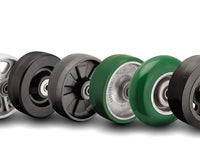

Quick Facts
|
Construction |
Single-piece gray iron construction, machined hub |
|
Profile |
Flat or slightly rounded tread profile |
|
Bearing |
Roller, ball, or plain bearing options (varies by model) |
|
Hardness |
~145-170 Brinell |
|
Temperature |
-40°F to +600°F |
|
Typical Capacities |
~300–8,000 lb per caster (varies by size and rig) |
What Makes Cast Iron Casters a Popular Choice?
 Highly economical.
Cast iron casters offer one of the best cost-to-capacity ratios in the market. For applications where budget matters but rugged performance is still essential, cast iron is hard to beat.
Simple, proven design.
No tread bonding or multi-material construction—just solid iron. This makes for an inherently durable, impact-resistant caster in even challenging environments, including manufacturing or machining centers where oils or chemicals are present.
Heat-ready.
Cast iron performs well in high-temperature settings, far beyond the tolerance of rubber or synthetic wheels.
Smooth rolling on hard surfaces without debris.
Cast iron wheels roll with low resistance on concrete or hard floors, especially when paired with quality bearings.
Real Benefits for Operations
Affordable heavy-duty performance
Whether you’re outfitting carts, platforms, or machines, cast iron casters provide serious strength at a fraction of the cost of specialty wheels like polyurethane or forged steel.
Long service life in clean, controlled environments
Without exposure to moisture or corrosive materials, cast iron wheels can last many years with minimal wear or maintenance requirements.
Great for static positioning
Ideal for static positioning, as you will never flat spot on machinery or other forms of racks or equipment that does not move often.
Applications Where Cast Iron Excels
-
Industrial carts & mobile machinery
High-load, dependable wheel for industrial applications.
-
Manufacturing plants
Especially in metal fabrication, assembly lines, and foundries.
-
Warehousing and logistics
For industrial carts, platforms, and equipment stands.
-
Maintenance shops
Portable workbenches and equipment in rugged environments.
-
Construction & equipment staging
Heavy loads on unfinished or reinforced floors.

Cast Iron vs. Nylatron and Polyurethane Wheels
Feature |
|||
|
Affordability |
Excellent |
Moderate |
Moderate–High |
|
Noise Level |
High |
Moderate-Low |
Low |
|
Floor Protection |
Poor |
Moderate |
Excellent |
|
Load Capacity |
High |
High |
Moderate–High |
|
Heat Resistance |
Excellent |
Moderate |
Low |
|
Corrosion Risk |
Moderate |
Low |
Low (Medium if on Cast Iron core) |
|
Shock Absorption |
Very Low |
Moderate |
High |
Watch-Outs and Limitations
Noisy operation
Due to its nature, cast iron will roll louder than polyurethane-coated, rubber, or nylon wheels—especially on hard floors. Not ideal for noise-sensitive zones if moving often or regular far distances.
Floor damage potential
As a hard wheel, cast iron wheels can chip, mark, or wear down floors, particularly when debris is present or if it is a heavy load that is frequently traveled.
Poor shock absorption
Their solid design transfers impact to the equipment, making them not ideal for transporting fragile goods.
Rust risk—not ideal for wet environments
As a painted/enameled metal wheel, cast iron can corrode over time when exposed to humid or wet environments once paint/enamel is scratched or is worn down.
Spec Tips & Selection Notes
Environment & surface compatibility
Best used on smooth, unfinished, reinforced floors where floor wear isn’t a concern.
Use in dry, controlled spaces
Avoid usage in common wet areas over extended periods.
Rig & bearing pairing matters
To get the most from cast iron wheels, match them with quality rigs that will also handle the higher capacities along with quality industrial roller bearings that are maintained with adequate grease.
Avoid fragile load applications
These wheels are not shock-absorbing and are not recommended for delicate cargo or equipment.
Cast iron wheel casters offer dependable performance at an economical price point. Where floor wear, noise, or corrosion aren't concerns, they provide a tough, economical solution for heavy-duty rolling needs. From shop floors to manufacturing lines, these wheels prove that economical doesn’t have to be weak—making them a longstanding popular choice for customers around the world.
Watch our video here: